


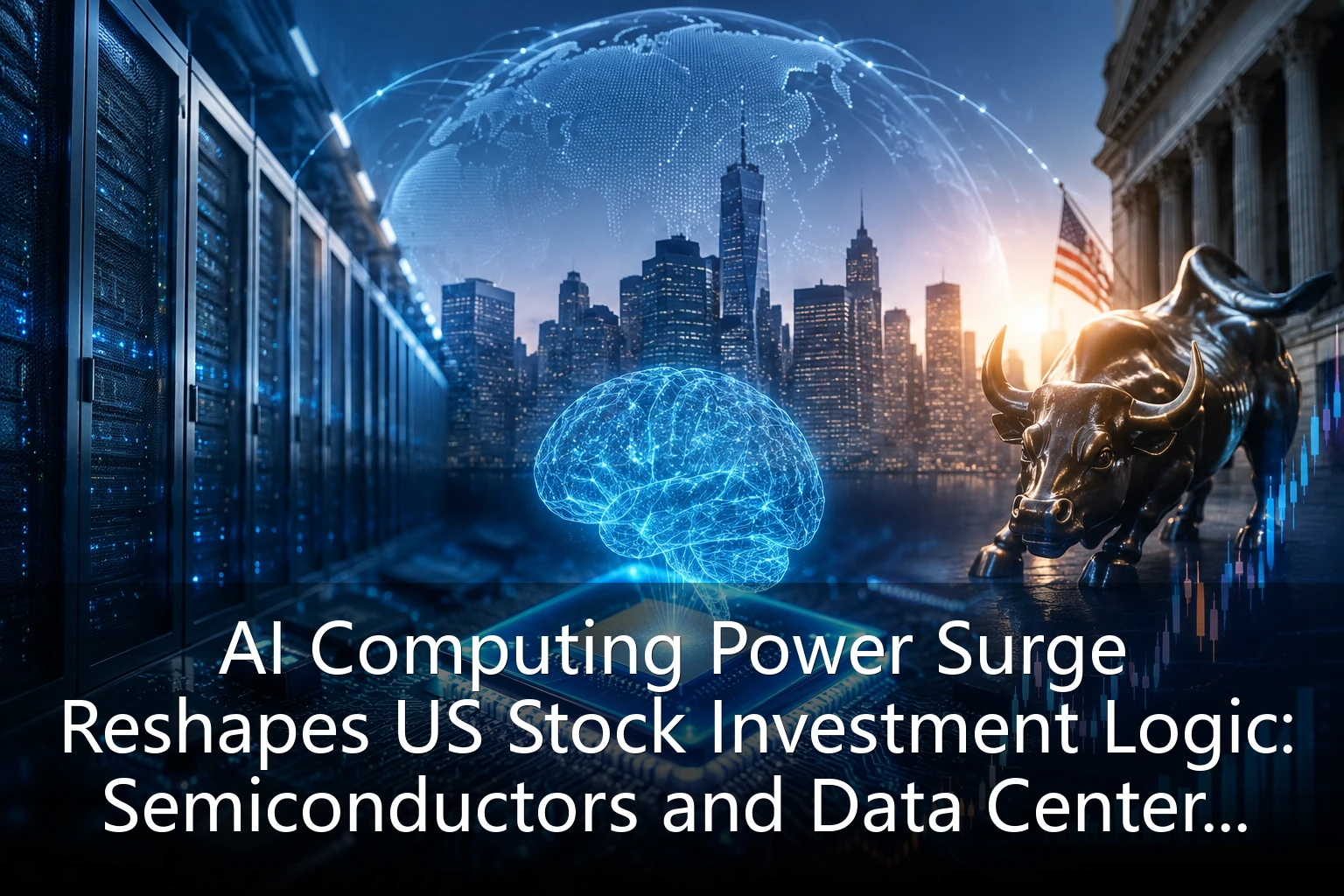
In midsummer 2026, the global macroeconomic environment is undergoing unprecedented complex tests. As the Federal Reserve's months-long interest rate policy game draws to a close, market funds are shifting from blind pursuit of liquidity expectations to deep allocation in hardcore assets with solid fundamental support. In this grand narrative of capital migration, the tech sector centered on AI computing power is reshaping the investment logic of the US stock market with its unparalleled growth certainty. Semiconductor hardware and data center infrastructure, two traditional industries once considered subject to cyclical fluctuations, have now transformed into safe havens where global capital flocks in turbulent markets.
Computing Power is Power: AI Large Model Competition Enters White-Hot Stage of Computing Power Arms Race
Looking back at the history of technological development in recent years, the generative AI frenzy triggered by large language models in 2023 has completely evolved into an arms race for strategic resources centered on computing power by 2026. With AI model parameters leaping from hundreds of billions to trillions, and the explosion of demand for massive video and audio data processing in multimodal large models, global tech giants' thirst for underlying computing power has reached the critical point of exponential growth.
Against this backdrop, the semiconductor industry chain in the US stock market has ushered in an epic period of performance release. From the absolute hegemon of high-end GPUs, to switch chip manufacturers responsible for high-speed data transmission, to core suppliers in the Chiplet advanced packaging field, order visibility across the entire upstream and downstream industry chain has extended into the next several quarters. This long-cycle prosperity driven by real demand contrasts sharply with past short-cycle fluctuations relying on consumer electronics replacement cycles. For investors, this means the valuation logic of tech stocks is undergoing fundamental reconstruction: gradually shifting from the traditional PE (Price-to-Earnings) pricing model to a discounted future cash flow model centered on computing power market share and R&D pipeline barriers.
Hardware Infrastructure: The Underlying Cornerstone Supporting AI Prosperity
Behind the computing power frenzy, data centers, as the physical entities carrying computing power, are experiencing a massive expansion and upgrade movement. In 2026, global hyperscale data center capital expenditures are expected to hit record highs. This trend not only directly drives demand for hardware equipment such as complete servers, liquid cooling systems, and Uninterruptible Power Supplies (UPS), but also poses unprecedented challenges to US power infrastructure.
Market research data shows that industrial electricity demand in multiple core computing power hub areas of the US is surging. This thirst for resources spreading from the virtual world to the physical world means the investment logic of data centers is no longer confined to simple Real Estate Investment Trusts (REITs), but is deeply embedded in the value distribution of the tech industry chain. In the US stock market, data center operators with ample power quotas and large-scale cluster scheduling capabilities are enjoying dual enhancements in valuation and performance, becoming important targets for global long-term capital allocation.
Resisting Macroeconomic Volatility: Why Have US Tech Assets Become a Safe Haven for Global Capital?
In the second half of 2026, the global macroeconomy still faces multiple pressures: geopolitical frictions, partial supply chain restructuring, and the difficulty of the inflation core quickly falling back to the 2% target. In such a complex environment, why does global capital still firmly choose US stocks, especially the tech computing power sector, as the core allocation stronghold? Hangu Financial Research believes this mainly stems from three core advantages displayed by the US stock market in the current cycle.
First, an unparalleled global innovation monopoly position.
The US stock market gathers the world's top tech giants and leading semiconductor companies. These companies not only master cutting-edge technology patents but also build extremely deep moats through massive software ecosystems and developer communities. In the profit distribution pattern of the global AI industry chain, US companies firmly occupy both ends of the "Smile Curve": namely upstream underlying chip design and architecture standard setting, and downstream cloud model services and ecosystem monetization. This monopoly on high-value-added links enables the US tech sector to effectively resist price involution in overseas low-end manufacturing links, thereby maintaining astonishingly high gross margins amid macroeconomic volatility.
Second, robust free cash flow and proactive shareholder return mechanisms.
Against the backdrop of the Federal Reserve maintaining a relatively high interest rate environment, capital costs remain high. However, top US tech companies, with abundant free cash flow, can not only support tens of billions of dollars in massive R&D investments annually but also provide generous returns to investors through large-scale stock buybacks and continuously growing dividend payouts. This dual attribute of "high growth + high return" is unique among major global equity markets. While other global markets face corporate survival pressures due to tightening financing environments, US tech giants use their robust capital barriers to continuously consolidate market positions, even integrating industry chain resources through countercyclical mergers to further widen the gap with competitors.
Third, highly institutionalized and extremely liquid market mechanisms.
Facing complex market sentiment shifts in 2026, the highly developed market maker mechanism and T+0 trading system of the US stock market have shown strong buffering capacity. Abundant market liquidity means massive capital inflows and outflows will not cause irreversible impacts on stock prices, providing an ideal asset allocation pool for global large macro hedge funds and sovereign wealth funds. In addition, the US market's extremely comprehensive risk hedging tool system, such as rich options strategies, allows investors to hedge tail risks through derivatives while holding long positions in core computing power assets, greatly enhancing the risk-adjusted returns of portfolios.
In-Depth Industry Chain Decoding: The Wealth Transmission Path from Chips to the Cloud
For rational investors, merely recognizing the long-term trend of AI computing power is insufficient; it is even more necessary to deeply understand the wealth transmission path within the industry chain to avoid falling into valuation bubble traps. In the current computing power arms race, value creation and distribution are not evenly distributed but show obvious transmission and diffusion characteristics.
First is the computing power chip design link at the top of the value chain. This field has extremely high concentration, and the oligopoly pattern gives top enterprises powerful pricing power. With the mass production of new-generation AI accelerator cards, the substantial increase in computing power density per card, while alleviating computing power bottlenecks to a certain extent, also brings high power consumption and cooling challenges. This directly spawned the prosperity of advanced packaging technologies, such as the rapid increase in penetration rates of 2.5D and 3D packaging technologies, and related equipment suppliers and material manufacturers have ushered in a deterministic performance realization period.
Secondly, the construction of computing power networks cannot be ignored. Inside data centers, to break the "memory wall" effect, the upgrade speed of data transmission bandwidth has even surpassed the growth of computing power itself. The large-scale deployment of 800G and even 1.6T high-speed optical modules, along with the iterative upgrade of high-speed Ethernet switch chips, constitute the key lifeblood for AI computing power cluster Scaling Up. In the US stock market, leading companies in this niche track, relying on first-mover technological advantages, have seen revenue growth rates even surpass those of some large model companies, becoming an elastic direction for competitive capital allocation.
Furthermore, with the drastic expansion of computing power scale, energy consumption issues have become the biggest bottleneck restricting development. Liquid cooling technology moving from laboratories to commercial data centers has become a major focus of infrastructure investment in 2026. From cold plate liquid cooling to immersion liquid cooling, traditional thermal management enterprises are undergoing profound technological route transformations. The capital market's pricing logic for this field has also shifted from traditional hardware manufacturing valuation to a tech growth stock valuation system with core technology patents and patent barriers. This provides investors with forward-looking vision rich thematic investment opportunities.
Investment Strategy and Risk Warning: Stay Rational Amid Frenzy, Build Countercyclical Portfolios
Facing the current high prosperity of the US tech sector, especially the computing power industry chain, investors should not only seize the era's dividend but also maintain high vigilance against potential risks when formulating allocation strategies. Hangu Financial Research suggests that allocating US computing power assets at this current node should follow these core principles:
1. Stick to core assets, embrace the certainty premium. In the AI era of rapid technological iteration, blindly chasing marginal concept stocks faces extreme risks of going to zero. Investors should allocate core positions to giant enterprises with deep ecosystem moats, abundant R&D funds, and the ability to continuously provide high shareholder returns. These enterprises can not only survive short-term macro cycles but also further increase market share through mergers and integration during industry reshuffles.
2. Seek highly elastic niche leaders, grasp the industry chain diffusion dividend. While core assets provide basic beta returns, investors can, through in-depth fundamental research, find small and mid-cap growth stocks with reasonable valuations and impending technological breakthroughs in highly elastic niche tracks such as advanced packaging, high-speed optical interconnects, and liquid cooling, to obtain excess alpha returns.
3. Beware of valuation bubbles and geopolitical tail risks. Currently, the valuations of some computing power concept stocks have already priced in high growth expectations for the next few years. Once downstream large model commercialization falls short of expectations, it may trigger a severe sector correction. In addition, the highly globalized division of labor in the semiconductor industry chain makes it highly susceptible to international trade frictions and export control policies. Investors need to closely monitor relevant policy trends, hedging black swan event risks through diversified allocation or options tools.
In summary, the global capital market in 2026 is undergoing profound changes driven by the AI computing power frenzy. With its comprehensive advantages in technological innovation, capital liquidity, and corporate governance mechanisms, the US stock market remains the preferred destination for global capital to allocate tech growth assets. For Chinese investors, participating in the US stock market through compliant channels is not only a necessary means to hedge single-market economic cycle risks, but also an essential path to share the dividends of the global cutting-edge tech revolution and achieve cross-cycle wealth appreciation. In an unpredictable market environment, only by profoundly understanding the internal logic of the computing power industry chain can one move steadily and far in this epic investment feast.