

U.S. Charitable Giving Tops $600 Billion for the First Time: Driven by Ultra-wealthy Donors and Bequests
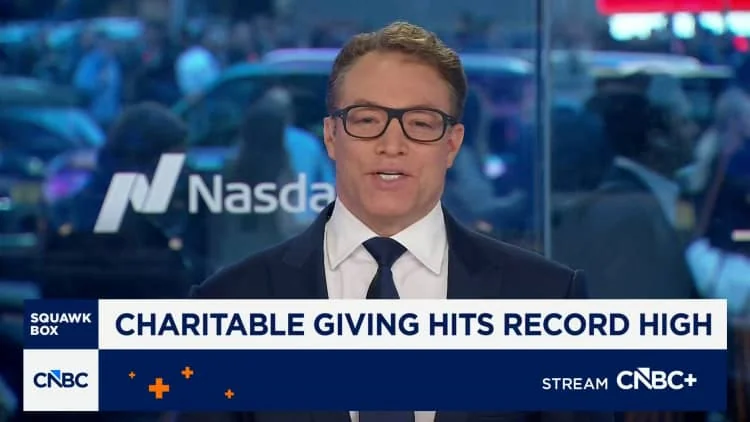
According to estimates in the Giving USA report released by the Giving USA Foundation, total U.S. charitable giving last year was $617.2 billion, up 5.7% from the year before, mainly thanks to a strong stock market rally.
It was also the first time in the 60-year history of the annual charitable giving report that yearly giving exceeded $600 billion. After adjusting for inflation, giving rose 3% year over year.
The market boom had an even bigger effect on deep-pocketed donors. Individual giving still made up the largest share at $394.2 billion, but after inflation it rose only 1.4%. By contrast, charitable bequests (donations received after a donor's death) jumped 16.6% to an estimated $62.19 billion.
The rise in bequests may be the latest sign of the Great Wealth Transfer. Cerulli Associates estimates that more than $124 trillion in assets will pass between generations by 2048, with about $18 trillion going to charity.
Jon Bergdoll, the report's lead analyst, said it is still too early to tell how much of the bequest growth comes from this massive transfer of wealth.
What is clearer is this: the wealthy Americans most likely to leave large gifts to charity are also the biggest beneficiaries of the stock market boom. Bergdoll noted, 'There is a fairly close link between bequests and overall net worth, and net worth is tied to market performance.' The research and report were advanced by the data and research partnership team at Indiana University's Lilly Family School of Philanthropy.
Stock Market Gains Did Not Translate Proportionally Into Total Giving
Bergdoll said that overall giving, including foundation and corporate giving, responds more slowly and more mildly to the stock market. He expected total giving to have risen more sharply given the market's strong growth in recent years.
The report shows that between 2024 and 2025, the inflation-adjusted S&P 500 rose 13.4%, while the growth rate of total giving over the same period was only about a quarter as fast.
He partly blamed the gap on nominal wealth rising faster than macro fundamentals: GDP growth was weak and consumer confidence was at historic lows.
It's a somewhat unusual economic environment: the market is doing well, GDP is still okay, but there seems to be a lot of unease. We know that giving often comes from people's sense of financial security, so that may be dragging on individual giving.
Bergdoll further stressed that if charitable giving tracks stock market swings too closely, that is not ideal for the nonprofit sector. We do not want a one-to-one relationship. Of course, we would like giving to rise 20% when the market rises 20%, but we also do not want giving to fall 20% when the market falls 20%.
Tax Incentives and Reliance on the Ultra-wealthy: The Giving Structure Is Changing
The report said some high-income groups were expected to pull forward donations in 2025 to take advantage of tax breaks, but those incentives may decline due to changes in the One Big Beautiful Bill Act. Bergdoll said the incremental effect of accelerated giving is notable, but still limited relative to overall giving.
The report estimates that donors added an extra $1.71 billion in donations in 2025 to make fuller use of expiring tax incentives.
Although U.S. charities received more money, the funding sources are becoming more dependent on the ultra-wealthy. The report estimates that last year, after economic pressure squeezed middle-class donors, nine donors together accounted for $22.32 billion in giving. The largest share came from philanthropist MacKenzie Scott, who contributed the biggest single amount at $6.65 billion.
These mega-gifts (at least 0.1% of total giving) can significantly change philanthropy from year to year. Nearly one-third of the bequest growth came from the estate of the late Microsoft co-founder Paul Allen, which established a $3.1 billion fund for science and technology research.
Gabe Cooper, vice chair of the Giving USA Foundation, said in an interview that he had mixed feelings. On the one hand, he hopes more billionaires will put their wealth to philanthropic use; on the other, he does not want dependence on the ultra-wealthy to keep growing because their giving patterns can be more volatile from year to year.
He also pointed to a more important concern: heirs. Cooper said that if a billionaire dies and leaves $200 million to charity, the much larger remainder may still go to their children, so he hopes heirs will make better choices when it comes to charitable decisions.